




Special Price for Clock Integrated Circuit - TCAN1042HGVDRQ1 SOP8 Electronic Components Distribution New Original Tested Integrated Circuit Chip IC TCAN1042HGVDRQ1 – Yingnuode
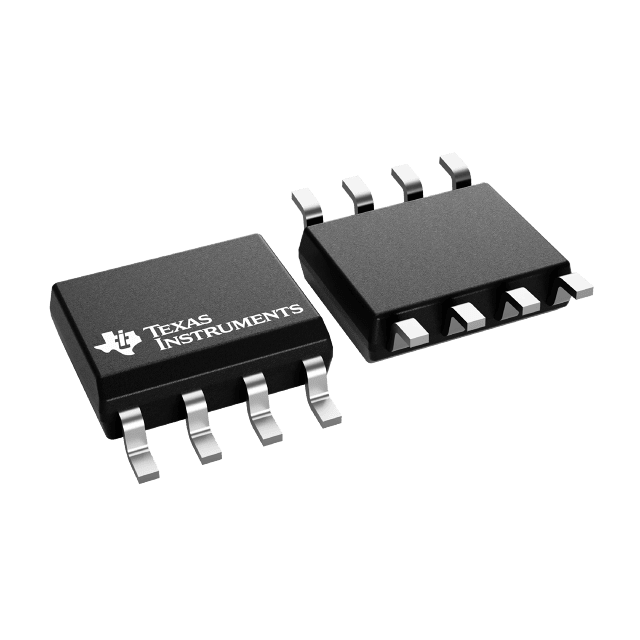
Special Price for Clock Integrated Circuit - TCAN1042HGVDRQ1 SOP8 Electronic Components Distribution New Original Tested Integrated Circuit Chip IC TCAN1042HGVDRQ1 – Yingnuode Detail:
Product Attributes
| TYPE | DESCRIPTION |
| Category | Integrated Circuits (ICs) |
| Mfr | Texas Instruments |
| Series | Automotive, AEC-Q100 |
| Package | Tape & Reel (TR)
Cut Tape (CT) Digi-Reel® |
| SPQ | 2500 T&R |
| Product Status | Active |
| Type | Transceiver |
| Protocol | CANbus |
| Number of Drivers/Receivers | 1/1 |
| Duplex | - |
| Receiver Hysteresis | 120 mV |
| Data Rate | 5Mbps |
| Voltage – Supply | 4.5V ~ 5.5V |
| Operating Temperature | -55°C ~ 125°C |
| Mounting Type | Surface Mount |
| Package / Case | 8-SOIC (0.154″, 3.90mm Width) |
| Supplier Device Package | 8-SOIC |
| Base Product Number | TCAN1042 |
1.
PHY is a rising star in in-vehicle applications (such as T-BOX) for high-speed signal transmission, while CAN is still an indispensable member for lower-speed signal transmission. The T-BOX of the future will most likely need to display vehicle ID, fuel consumption, mileage, trajectory, vehicle condition (door and window lights, oil, water and electricity, idle speed, etc.), speed, location, vehicle attributes, vehicle configuration, etc. on the car network and mobile car network, and these relatively low-speed data transmission is relying on the main character of this article, CAN.
The CAN bus was introduced by Bosch in Germany in the 1980s and has since become an integral and important part of the car. To meet the different requirements of in-vehicle systems, the CAN bus is divided into high-speed CAN and low-speed CAN. high-speed CAN is mainly used for the control of power systems that require high real-time performance, such as engines, automatic transmissions, and instrument clusters. Low-speed CAN is mainly used for the control of comfort systems and body systems that require less real-time performance, such as air conditioning control, seat adjustment, window lifting, and so on. In this article, we will focus on high-speed CAN.
Although CAN is a very mature technology, it still faces challenges in automotive applications. In this paper, we will look at some of the challenges CAN is facing and introduce the relevant technologies to address them. Finally, the advantages of TI’s CAN applications and its rather “hardcore” products will be described in detail.
2.
Challenge one: EMI performance optimization
As the density of electronics in vehicles increases each year, the electromagnetic compatibility (EMC) of in-vehicle networks is being demanded even more, because when all components are integrated into the same system, it is essential to ensure that the subsystems work as expected, even in the face of noisy environments. One of the major challenges faced by CAN is the exceedance of conducted emissions caused by common mode noise.
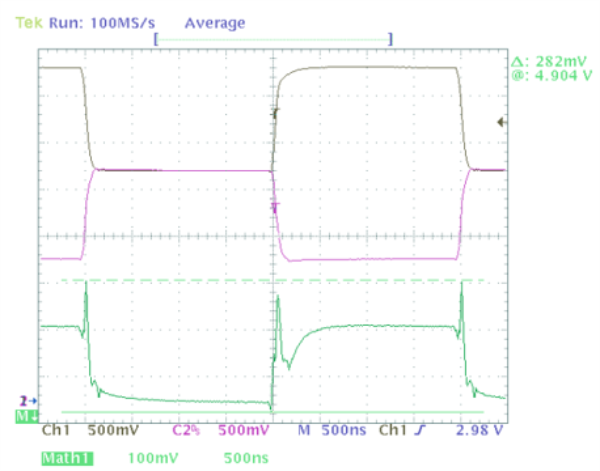
Ideally, CAN uses differential link transmission to prevent external noise coupling. In practice, however, CAN transceivers are not ideal and even a very slight asymmetry between CANH and CANL can produce a corresponding differential signal, which causes the common mode component of CAN (i.e. the average of CANH and CANL) to cease to be a constant DC component and become data-dependent noise. There are two types of imbalance that result in this noise: low-frequency noise caused by a mismatch between the steady state common mode level in the dominant and recessive states, which has a wide frequency range of noise patterns and appears as a series of uniformly spaced discrete spectral lines; and high-frequency noise caused by the time difference between the transition between dominant and recessive CANH and CANL, which consists of short pulses and disturbances generated by data edge jumps. Figure 1 below shows an example of typical CAN transceiver output common mode noise. Black (channel 1) is CANH, purple (channel 2) is CANL and green indicates the sum of CANH and CANL, the value of which is equal to twice the common mode voltage at a given point in time.
Product detail pictures:
Related Product Guide:
We are going to dedicate ourselves to providing our esteemed buyers together with the most enthusiastically thoughtful products and services for Special Price for Clock Integrated Circuit - TCAN1042HGVDRQ1 SOP8 Electronic Components Distribution New Original Tested Integrated Circuit Chip IC TCAN1042HGVDRQ1 – Yingnuode , The product will supply to all over the world, such as: Adelaide, Lesotho, Uruguay, Item have passed by means of the national qualified certification and been well received in our main industry. Our expert engineering team will often be ready to serve you for consultation and feedback. We have been able to also deliver you with cost-free samples to meet your specs. Ideal efforts will probably be produced to deliver you the most beneficial service and solutions. Should really you be interested in our company and solutions, please make contact with us by sending us emails or call us straight away. To be able to know our solutions and enterprise. ar more, you'll be able to come to our factory to see it. We will constantly welcome guests from all over the world to our firm. o build business enterprise. elations with us. You should feel absolutely free to speak to us for organization. nd we believe we are going to share the best trading practical experience with all our merchants.
 By Dominic from Austria - 2017.05.21 12:31
The customer service reprersentative explained very detailed, service attitude is very good, reply is very timely and comprehensive, a happy communication! We hope to have a opportunity to cooperate.
By Carey from Puerto Rico - 2018.02.08 16:45
-
China Cheap price Ic Chips - Semicon Microcont...
-
High reputation Integrated Digital Electronics ...
-
Popular Design for Instruments Integrated Circu...
-
Discount wholesale Linear Ic Digital Ic - Semi...
-
PriceList for Integrated Oscillator - TCAN1042...
-
Factory Cheap Hot Integrated Amplifier Circuit ...